
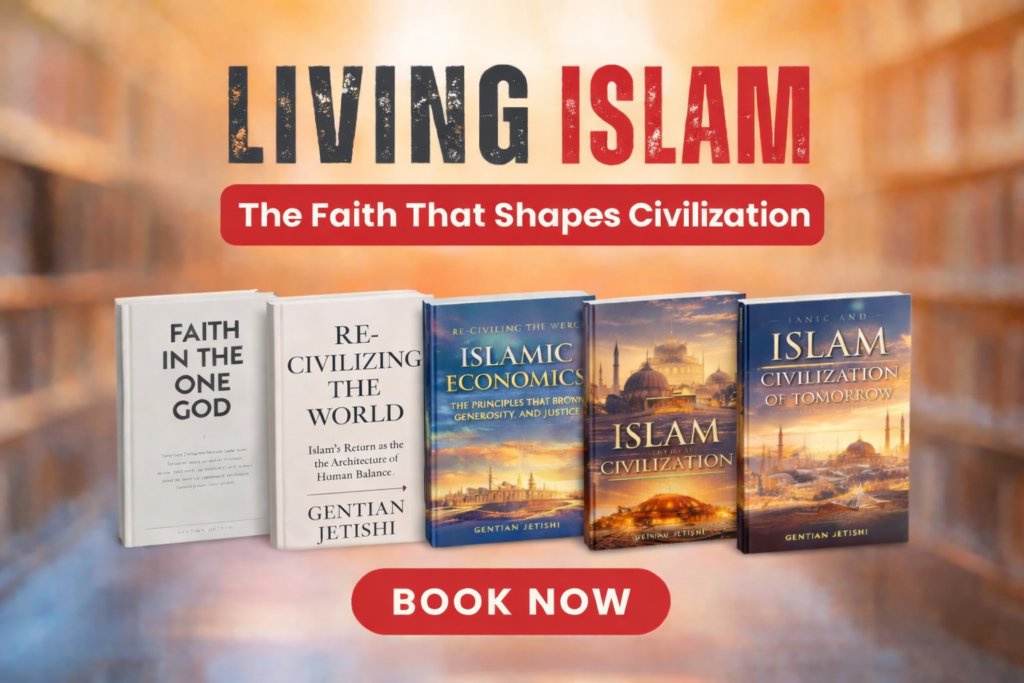
In an era marked by moral fragmentation, identity confusion, and civilizational uncertainty, few contemporary book projects attempt to address the deeper question beneath global crises: What gives civilizations meaning, balance, and direction?
The book series Living Islam: The Faith That Shapes Civilization represents one of the most ambitious intellectual efforts to engage this question from within the Islamic worldview — not as nostalgia, but as a forward-looking civilizational vision.
Unlike many works that treat Islam either as a purely theological system or as a sociopolitical phenomenon, Living Islam approaches faith as a living architecture of meaning — one that shapes the individual, structures society, and sustains civilization over time.
Faith Beyond Ritual: Islam as a Living Worldview
At the core of the Living Islam series lies a fundamental premise: faith is not meant to be confined to private belief or ritual practice alone. Instead, Islam is presented as a comprehensive worldview that integrates belief, ethics, knowledge, economics, social responsibility, and culture into a coherent civilizational framework.
Each volume addresses a specific dimension of Islamic thought — from foundational beliefs such as Faith in One God, Faith in Angels, and Faith in the Afterlife, to applied domains including ethics, economics, social justice, purification, worship, and civilizational renewal. Together, these works form a structured intellectual journey inspired by the 23 years of prophetic revelation, mirroring the gradual formation of faith, consciousness, and society.
A Civilizational Reading of Islam
One of the distinguishing features of the series is its civilizational lens. Islam is not treated merely as a historical phenomenon or a cultural identity, but as a dynamic moral system capable of responding to modern challenges.
Volumes such as Re-Civilizing the World and Islamic Civilization of Tomorrow explore how Islamic principles address contemporary crises — from ethical decay and economic imbalance to the loss of human purpose. Rather than offering ideological slogans, the series emphasizes balance (mīzān), responsibility (amānah), and ethical coherence as foundations for sustainable human societies.
This approach situates Living Islam within broader global conversations on civilization, ethics, and the future of humanity — making it relevant not only to Muslim readers, but also to interfaith audiences, academics, and thoughtful secular readers.
An Accessible Yet Serious Intellectual Style
Written by Gentian Jetishi, the series combines clarity of language with intellectual seriousness. The books avoid both apologetic defensiveness and academic obscurity, aiming instead for a style that is reflective, structured, and accessible.
This balance allows Living Islam to function simultaneously as:
- an educational resource for students of Islamic studies,
- a reflective guide for spiritual seekers,
- and a civilizational framework for readers concerned with ethics, meaning, and social cohesion.
More information about the series and its conceptual foundations can be explored on the official website:
👉 https://livingislamthefaiththatshapescivilization.com/
Positioning in the Global Intellectual Landscape
What makes Living Islam particularly notable is its positioning within the global intellectual marketplace. Rather than framing Islam in opposition to modernity, the series presents it as a participant in shaping the future — offering ethical depth where technological progress alone falls short.
The books are available internationally through major platforms, including:
- Amazon: https://www.amazon.com/dp/B0FKBKQF61
- Google Play Books (series): https://play.google.com/store/books/series?id=peb_haaaabdb_m
This accessibility reinforces the project’s global orientation and its engagement with Western audiences seeking nuanced perspectives on Islam beyond headlines and stereotypes.
A Project of Long-Term Relevance
Living Islam: The Faith That Shapes Civilization is not a short-term publishing venture, but a long-term intellectual project. Its strength lies in its coherence, scope, and refusal to reduce Islam to either politics or ritualism.
By presenting faith as a force that shapes individuals, communities, and civilizations, the series contributes meaningfully to contemporary discussions on identity, ethics, and the future of human coexistence.
For readers searching for depth over noise, meaning over slogans, and faith understood as a constructive civilizational force, Living Islam offers a serious and timely contribution.
Author & project resources:
🔗 Official e-books: https://gentianjetishi.com/e-book